

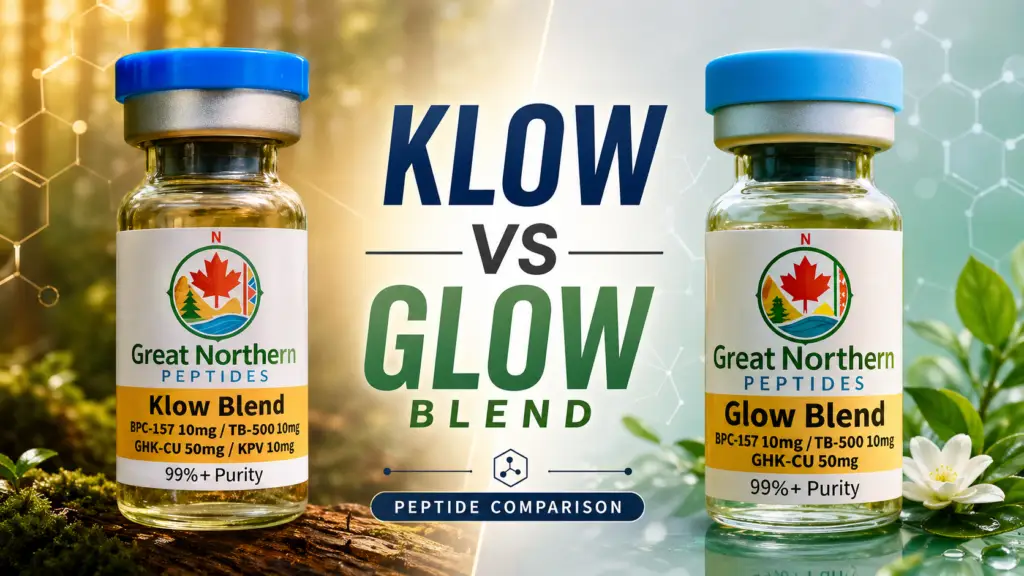
When you are comparing Klow vs Glow peptide, the real question is not which name sounds better — it is which formula matches your goal. At Great Northern Peptides, both blends share the same healing foundation, but Klow adds an extra peptide for stronger inflammation and immune support. This guide breaks down exactly what is in each vial, what each peptide does, and how to choose between them. If you want a broader look at the two core recovery compounds behind these formulas, read our BPC-157 and TB-500 healing peptides guide. If you want the direct side-by-side version, see our BPC-157 vs TB-500 comparison.
In This Guide
What Is The Difference Between Klow And Glow Peptide?
What Is Actually In Each Blend
How Klow Peptide Works And Why People Use It
How Glow Peptide Works And What Makes It Different
Klow Vs Glow Peptide: Benefits, Results, And Best Use Cases
Safety, Quality, And What To Check Before You Buy
Compare Peptide Options With Great Northern Peptides
FAQ About Klow Vs Glow Peptide
What Is The Difference Between Klow And Glow Peptide?
Klow and Glow are both research peptide blends from Great Northern Peptides built around the same healing and skin-rejuvenation foundation. The short answer is simple: Glow is a three-peptide blend focused on skin, collagen, and tissue repair, while Klow is the same three peptides plus KPV for added inflammation and immune support.
Here is the side-by-side composition:
| Blend | Total Content | Peptides Included | Price |
|---|---|---|---|
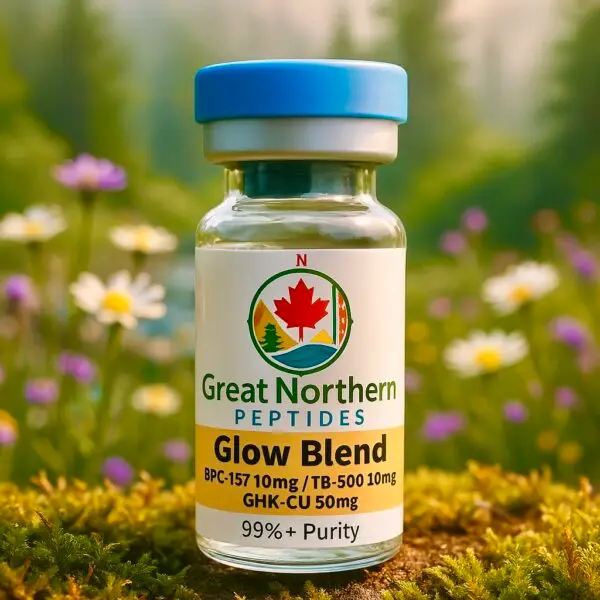
| Glow Blend | 70 mg | TB-500 10 mg, BPC-157 10 mg, GHK-Cu 50 mg | $100 |
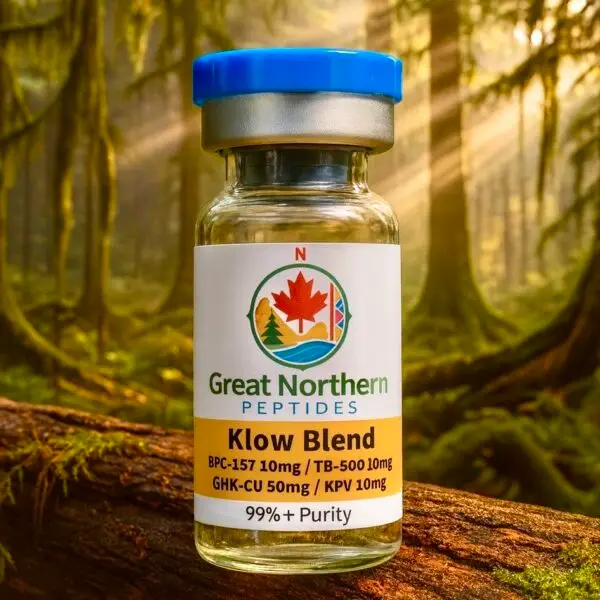
| Klow Blend | 80 mg | TB-500 10 mg, BPC-157 10 mg, GHK-Cu 50 mg, KPV 10 mg | $110 |
Because both blends share TB-500, BPC-157, and GHK-Cu, the comparison really comes down to whether the extra 10 mg of KPV in Klow matches your goals. If your focus is skin appearance, collagen support, and general recovery, Glow may be all you need. If you also want stronger inflammation modulation, gut support, or immune-pathway research, Klow is the more complete option.
If you would like a broader foundation before comparing blends, our guide to understanding peptides and their uses gives helpful context.
What Is Actually In Each Blend
Both vials are built around the same three-peptide healing core — TB-500, BPC-157, and GHK-Cu — and Klow Blend 80 mg simply adds KPV on top of what is in Glow Blend 70 mg. The table below shows what each peptide does and which blend(s) it appears in.
| Peptide | Amount | Primary Role In The Blend | Included In |
|---|---|---|---|
| TB-500 | 10 mg | Tissue regeneration, cell migration, angiogenesis, and recovery from physical stress | Klow & Glow |
| BPC-157 | 10 mg | Soft tissue repair, gut support, and inflammation reduction | Klow & Glow |
| GHK-Cu | 50 mg | Collagen production, skin elasticity, and anti-inflammatory signaling | Klow & Glow |
| KPV | 10 mg | Targeted anti-inflammatory and immune-pathway support | Klow only |
The Shared Three-Peptide Core (Klow & Glow)
TB-500 and BPC-157 work together as the regenerative backbone, supporting cell migration, soft tissue repair, gut integrity, and inflammation reduction across muscles, connective tissue, and the digestive tract. GHK-Cu makes up the largest share of either blend at 50 mg and is the copper peptide most associated with collagen production, improved skin elasticity, and anti-inflammatory signaling — the same component that drives much of the visible “glow” effect in skin-focused research.
The Extra Peptide In Klow: KPV (10 mg)
KPV is the only peptide that sets Klow apart from Glow. It is recognized for its potential to target inflammatory pathways and support immune regulation, adding an extra layer of inflammation and recovery support on top of the shared three-peptide base.
Product specifications: Glow Blend totals 70 mg and Klow Blend totals 80 mg of combined active peptides. Both are 99%+ purity verified by HPLC, supplied as a white and blue-tinted lyophilized powder, and stored cool and dry (refrigerated after reconstitution). For research and laboratory purposes only.
How Klow Peptide Works And Why People Use It
Klow works by stacking four peptides that hit healing, skin, and inflammation from multiple angles at once. TB-500 and BPC-157 drive tissue regeneration and soft tissue repair. GHK-Cu supports collagen synthesis and skin quality. KPV layers in additional inflammation and immune-pathway support that is not present in Glow.
People typically choose Klow when they want the most complete healing and recovery research blend Great Northern Peptides offers. Common reasons include:
- Comprehensive recovery support across muscle, connective tissue, and gut
- Stronger inflammation modulation than Glow alone
- Skin and collagen support from the 50 mg of GHK-Cu
- A single, organized blend instead of stacking individual vials
Because Klow contains everything in Glow plus KPV, it is the more thorough option when inflammation, gut support, or immune-pathway research is part of the picture.
How Glow Peptide Works And What Makes It Different
Glow is built on a tighter, three-peptide synergy. The combination of TB-500, BPC-157, and GHK-Cu emphasizes skin renewal, collagen support, and tissue recovery without the additional inflammation layer that KPV provides in Klow.
Glow tends to be the better fit when:
- Skin appearance, elasticity, and collagen are the main goals
- Recovery support is wanted, but heavy inflammation work is not the focus
- A simpler, lower-cost blend is preferred
- The research protocol does not specifically call for KPV
For a plain-language overview of how peptide pathways differ, this summary of peptide mechanisms and roles is useful background reading.
Klow Vs Glow Peptide: Benefits, Results, And Best Use Cases
Because Klow and Glow share three of the same peptides, their benefit profiles overlap significantly. The differences come down to scope and intensity of support.
| Goal | Better Fit | Why |
|---|---|---|
| Skin glow, tone, and elasticity | Either (Glow is simpler) | Both contain 50 mg GHK-Cu, the main skin-focused peptide |
| Collagen support | Either | Same GHK-Cu dose in both blends |
| Soft tissue and muscle recovery | Either | Same TB-500 and BPC-157 doses in both blends |
| Gut support | Either (Klow is stronger) | BPC-157 in both; KPV adds further inflammation support |
| Inflammation modulation | Klow | KPV is included specifically for inflammatory pathways |
| Immune-pathway research | Klow | KPV is the differentiating peptide here |
| Simpler, lower-cost blend | Glow | Three peptides at $100 vs four peptides at $110 |
| Most complete healing stack | Klow | Adds KPV on top of the full Glow formula |
A side-by-side comparison of typical positioning:
| Comparison Point | Klow Blend | Glow Blend |
|---|---|---|
| Number of peptides | 4 | 3 |
| Total content | 80 mg | 70 mg |
| Shared peptides | TB-500, BPC-157, GHK-Cu | TB-500, BPC-157, GHK-Cu |
| Unique peptide | KPV (10 mg) | None |
| Primary positioning | Healing, recovery, inflammation, skin | Skin renewal, collagen, recovery |
| Best for | Comprehensive recovery and inflammation work | Skin-focused research and general healing |
| Price | $110 | $100 |
Timeline expectations are similar for both blends. In the first 2 to 4 weeks, subtle changes are typical rather than dramatic before-and-after results. By 8 to 12 weeks, skin and recovery markers are easier to evaluate consistently.
Ready To Choose Your Blend?
Pick the formula that matches your goal — or grab one of each.
Want to try both? Many customers stack them.
Add Both Klow + Glow To Cart →Safety, Quality, And What To Check Before You Buy
Both Klow and Glow are for research and laboratory purposes only and not for human consumption. With any branded blend, the label only matters if the supplier can show what is in the vial, how strong it is, and how it was tested.
At Great Northern Peptides, both blends are independently lab-tested by Freedom Diagnostics Lab and verified at 99%+ purity by HPLC. A Certificate of Analysis is available for each batch.
Use this verification checklist before buying any branded peptide blend:
- Exact ingredient list with per-peptide dosing, not just a total mg figure
- Purity testing method (HPLC) and percentage
- Batch-specific Certificate of Analysis (COA)
- Clear lot numbers and traceability
- Storage guidance before and after reconstitution
- A reputable third-party testing lab
Both Klow and Glow contain GHK-Cu at 50 mg, so anyone with a known sensitivity to copper-containing peptides should take that into account. Evidence quality varies across peptide research, and neither blend is proven to deliver universal anti-aging or guaranteed recovery results — outcomes depend on the research context.
Compare Peptide Options With Great Northern Peptides
Choosing between Klow vs Glow peptide gets easier once you stop treating the product name as the answer. The better question is which formula fits the scope of your research and the level of support you actually need.
If you want the simpler, skin-and-recovery focused option, Glow Blend 70 mg is the more streamlined choice. If you want the most complete healing stack with added inflammation and immune support, Klow Blend 80 mg includes everything in Glow plus 10 mg of KPV.
Both ship directly from within Canada, are independently lab-tested, and arrive as 99%+ pure lyophilized powder ready for reconstitution. Explore the full peptide catalogue at Great Northern Peptides.
FAQ About Klow Vs Glow Peptide
What is the main difference between Klow and Glow Blend?
Both contain TB-500 10 mg, BPC-157 10 mg, and GHK-Cu 50 mg. Klow adds KPV 10 mg for additional inflammation and immune-pathway support, bringing it to 80 mg total versus Glow’s 70 mg.
Is Klow or Glow Blend better for skin?
Both contain the same 50 mg of GHK-Cu, the peptide most associated with collagen and skin elasticity. For purely skin-focused research, Glow is usually sufficient. Klow offers the same skin support plus extra inflammation modulation.
Is Klow Blend worth the extra cost over Glow?
For an extra $10, Klow adds 10 mg of KPV. Whether that is worthwhile depends on whether your research benefits from the additional inflammation and immune-pathway support KPV provides.
Can Klow and Glow be used together?
Because Klow already contains every peptide in Glow at the same doses, stacking them would mostly duplicate three of the four peptides. Klow on its own already covers everything Glow does, plus KPV.
How are Klow and Glow tested?
Both blends are independently lab-tested by Freedom Diagnostics Lab and verified at 99%+ purity by HPLC. A Certificate of Analysis is available for each batch.
How are Klow and Glow stored?
Both arrive as a lyophilized (white and blue-tinted) powder. Store cool and dry before reconstitution and refrigerated after mixing. Both products are for research and laboratory purposes only.