

What Is Retatrutide?
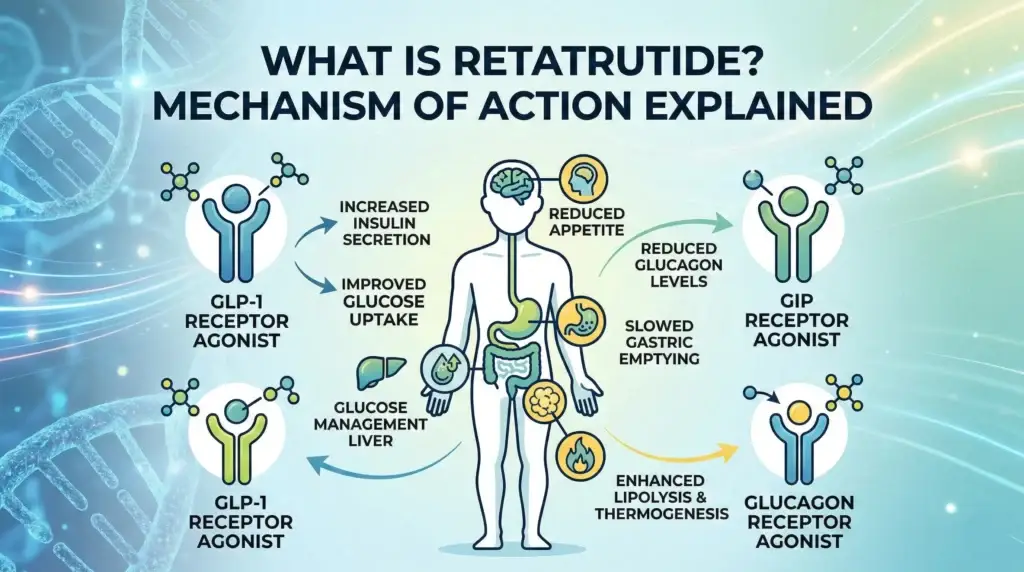
Retatrutide (LY3437943) is a novel triple-agonist peptide developed by Eli Lilly that simultaneously activates three incretin-related receptors. It belongs to one of several types of peptides classified by their receptor targets — in this case, a triple-agonist that engages: GLP-1 (glucagon-like peptide-1), GIP (glucose-dependent insulinotropic polypeptide), and glucagon receptors. This triple mechanism distinguishes retatrutide from dual-agonist compounds like tirzepatide (GLP-1/GIP) and single-agonist compounds like semaglutide (GLP-1 only). For a direct side-by-side on the dual-versus-triple agonist question, see our tirzepatide vs retatrutide guide.
As a research compound, retatrutide has generated significant interest in the scientific community for its unique pharmacological profile and its potential to modulate metabolic pathways through three distinct receptor targets simultaneously.
How Retatrutide’s Triple-Agonist Mechanism Works
GLP-1 Receptor Activation
The GLP-1 component of retatrutide activates receptors found predominantly in the pancreas and central nervous system. In research settings, GLP-1 receptor agonism has been associated with enhanced insulin secretion, reduced glucagon release, and modulation of appetite-related signalling pathways. This mechanism is well-characterized through decades of research into the incretin effect.
GIP Receptor Activation
GIP receptor agonism complements GLP-1 activity by engaging a parallel incretin pathway. Research published in Nature Metabolism suggests that combined GLP-1/GIP agonism may produce synergistic effects on metabolic regulation that exceed what either pathway achieves alone. GIP receptors are expressed in pancreatic beta cells, adipose tissue, and bone, offering a broader tissue-level engagement profile.
Glucagon Receptor Activation
The inclusion of glucagon receptor agonism is what truly sets retatrutide apart. While it may seem counterintuitive — glucagon is traditionally associated with raising blood glucose — research indicates that glucagon receptor activation increases energy expenditure, promotes hepatic lipid oxidation, and may contribute to the compound’s observed effects on body composition. Studies published in Cell Metabolism have explored how glucagon agonism in multi-receptor peptides contributes to metabolic outcomes beyond what GLP-1/GIP alone can achieve.
How Retatrutide Differs from Tirzepatide and Semaglutide
Understanding the differences between these three peptides is essential for researchers working in the metabolic peptide space:
- Semaglutide — Single-agonist targeting GLP-1 receptors only. Well-established research profile with extensive published clinical data.
- Tirzepatide — Dual-agonist targeting both GLP-1 and GIP receptors. Represents a step forward in multi-receptor peptide design.
- Retatrutide — Triple-agonist targeting GLP-1, GIP, and glucagon receptors. The broadest receptor engagement profile of the three, with the glucagon component adding a distinct thermogenic dimension.
For a detailed side-by-side comparison, see our guide on retatrutide vs tirzepatide vs semaglutide. If you want the semaglutide-specific angle, read our retatrutide vs Ozempic comparison.
Clinical Trial Results
Phase 2 trial data (published in The New England Journal of Medicine) demonstrated that participants receiving the highest dose of retatrutide achieved a mean body weight reduction of approximately 24.2% over 48 weeks — the largest reduction reported in any Phase 2 obesity trial to date. These findings have accelerated research interest and prompted Phase 3 investigations.
For the latest research updates, read our retatrutide clinical trials 2026 update.
Retatrutide for Research in Canada
Retatrutide is available as a research peptide in Canada for qualified researchers. Retatrutide is available for research in Canada through Great Northern Peptides, with third-party purity testing and domestic Canadian shipping.
For information on accessing research peptides in Canada, see our guide to retatrutide availability in Canada.
Frequently Asked Questions
What is retatrutide and how does it work?
Retatrutide (LY3437943) is a triple-agonist peptide that activates GLP-1, GIP, and glucagon receptors simultaneously. This three-receptor mechanism allows it to engage metabolic pathways through complementary signalling cascades, including appetite regulation, insulin modulation, and energy expenditure.
How is retatrutide different from semaglutide?
Semaglutide targets only GLP-1 receptors, while retatrutide targets GLP-1, GIP, and glucagon receptors. This triple mechanism gives retatrutide a broader pharmacological profile and a distinct research application in multi-receptor metabolic peptide studies.
What were the results of retatrutide clinical trials?
Phase 2 trials published in the New England Journal of Medicine showed up to 24.2% mean body weight reduction at the highest dose over 48 weeks, the most significant result reported in any Phase 2 trial for this class of compounds.
Can I buy retatrutide in Canada?
Retatrutide is available as a research peptide in Canada. Great Northern Peptides offers third-party tested retatrutide with domestic shipping for Canadian researchers.
Is retatrutide the same as tirzepatide?
No. Tirzepatide is a dual-agonist (GLP-1/GIP), while retatrutide is a triple-agonist (GLP-1/GIP/glucagon). The addition of glucagon receptor activation differentiates retatrutide’s pharmacological profile.
Explore the full range of third-party tested peptides Canada researchers rely on at Great Northern Peptides.