

Hair loss affects millions of Canadians, and while treatments like minoxidil and finasteride have been the standard for decades, a new class of compounds is gaining ground: peptides. These short chains of amino acids can stimulate hair growth, slow hair loss, and improve scalp health – often with fewer side effects than conventional treatments.
But with so many peptides on the market, which ones actually work for hair growth? In this guide, we compare the most researched peptides for hair loss, break down the science behind each one, and help you choose the right option for your hair restoration goals.
TL;DR: The Best Peptide for Hair Growth
GHK-Cu (copper peptide) is the clear winner. It has the strongest research backing, works through multiple biological pathways – including Wnt signalling activation, collagen synthesis, and anti-inflammatory action – and is available in both topical and injectable forms.
For androgenetic alopecia specifically, pair it with PTD-DBM for DHT-targeted support. For a full-spectrum approach, combine GHK-Cu with BPC-157 or TB-500. If you want a dedicated breakdown, see our guide to healing peptides for recovery and repair.
Below, we break down exactly why GHK-Cu leads the pack, how each peptide works, and which combinations match your specific type of hair loss.
What Are Peptides and How Do They Promote Hair Growth?
Peptides are short chains of amino acids – typically between 2 and 50 – that serve as building blocks for proteins like collagen, keratin, and elastin. Unlike full proteins, peptides are small enough to be readily absorbed by the body. There are many types of peptides, but healing and growth-signaling peptides are the categories most relevant to hair restoration research, making them effective in both topical and injectable formulations.
When it comes to hair growth, peptides work through several key mechanisms:
- Stimulating blood flow to hair follicles, delivering oxygen and nutrients essential for growth
- Boosting collagen and elastin production to strengthen hair structure from the root
- Reducing inflammation and oxidative stress on the scalp, which are major contributors to follicular miniaturization
- Activating Wnt/β-catenin signalling pathways that trigger the anagen (growth) phase of the hair cycle
- Modulating DHT levels and hormonal factors linked to androgenetic alopecia
That means peptides can target hair loss at the cellular level instead of just masking symptoms.
The Best Peptides for Hair Growth: Head-to-Head Comparison
Not all peptides are created equal when it comes to hair restoration. Below is a comprehensive comparison of the top peptides backed by research for their hair growth potential.
Quick Comparison Table
| Peptide | Primary Mechanism | Application | Evidence Level | Best For |
| GHK-Cu | Anti-inflammatory, collagen synthesis, Wnt activation | Topical & Injectable | Strong (multiple studies) | Overall hair restoration |
| BPC-157 | Angiogenesis, tissue repair, growth factor upregulation | Injectable | Moderate (animal studies) | Hair loss with scalp damage |
| TB-500 | Stem cell migration, blood vessel formation | Injectable | Moderate (preclinical) | Thinning hair, slow growth |
| PTD-DBM | Wnt pathway activation, DHT antagonism | Topical | Emerging (promising preclinical) | Androgenetic alopecia |
| Zinc Thymulin | Anti-androgen, follicle protection | Topical | Moderate (clinical trials) | Hormonal hair loss |
| AHK-Cu | Follicle enlargement, growth phase extension | Topical | Moderate | Fine, thinning hair |
GHK-Cu (Copper Peptide): The Gold Standard for Hair Growth
GHK-Cu (glycyl-L-histidyl-L-lysine copper) is the most researched peptide for hair restoration. This naturally occurring copper peptide was first identified in human plasma and has been studied for decades.
How GHK-Cu Works for Hair
- Activates the Wnt/β-catenin pathway – a critical signalling cascade that triggers dormant hair follicles to enter the anagen (active growth) phase
- Stimulates collagen synthesis and extracellular matrix remodelling, strengthening the dermal papilla that anchors each hair follicle
- Reduces inflammation and oxidative stress via SOD (superoxide dismutase) upregulation, protecting follicles from damage
- Increases blood vessel formation (angiogenesis), improving nutrient delivery to the scalp
- Promotes the expression of genes associated with hair growth while suppressing genes linked to hair loss
What the Research Says
A landmark study published in the Journal of Investigative Dermatology found that GHK-Cu increased hair follicle size by 29% in treated subjects. Subsequent research has confirmed that copper peptides can extend the anagen phase and improve hair density, with some studies showing comparable or superior results to 5% minoxidil – without the initial shedding phase many patients experience with minoxidil.
Application Methods
- Topical serums (most common): Applied directly to the scalp 1-2 times daily
- Subcutaneous injections: Typically administered at the scalp or abdomen for systemic effects
- Microneedling with GHK-Cu: Combines mechanical stimulation with peptide delivery for enhanced absorption
Best For
GHK-Cu is ideal for anyone experiencing general hair thinning, early-stage androgenetic alopecia, or age-related hair loss. It is the most versatile peptide for hair growth and works well as both a standalone treatment and in combination with other therapies.
BPC-157 (Body Protection Compound): The Tissue Repair Peptide
BPC-157 is a synthetic peptide derived from a protective protein found in human gastric juice. While it is best known for accelerating healing in tendons, muscles, and the gut, early research points to real potential for hair restoration.
How BPC-157 Works for Hair
- Promotes angiogenesis – the formation of new blood vessels – increasing blood flow to hair follicles
- Upregulates growth factors including VEGF (vascular endothelial growth factor) and FGF (fibroblast growth factor)
- Accelerates tissue repair, which is particularly beneficial for scarring alopecia or scalp damage from chemical treatments
- Reduces systemic inflammation that can contribute to diffuse hair thinning
- Supports nitric oxide pathways, improving microcirculation in the scalp
What the Research Says
While direct clinical trials on BPC-157 for hair loss are limited, animal studies have demonstrated significant wound healing and tissue regeneration effects. Its ability to enhance blood vessel formation and support growth factor expression provides a strong theoretical basis for hair growth applications. Anecdotal reports from the peptide community consistently describe improved hair density and reduced shedding.
Best For
BPC-157 is best suited for individuals whose hair loss is related to scalp damage, inflammation, or poor blood circulation. It pairs exceptionally well with GHK-Cu for a combined approach to hair restoration.
TB-500 (Thymosin Beta-4): The Stem Cell Activator
TB-500 is a synthetic fragment of thymosin beta-4, a naturally occurring peptide involved in cell migration, differentiation, and tissue repair. It activates stem cells within hair follicles, which makes it relevant for hair loss.
How TB-500 Works for Hair
- Activates hair follicle stem cells, promoting the transition from the telogen (resting) phase to the anagen (growth) phase
- Promotes keratinocyte migration – the cells responsible for producing keratin, the primary structural protein in hair
- Enhances blood vessel development in the scalp, similar to BPC-157
- Reduces inflammation and supports tissue remodelling around the hair follicle
What the Research Says
A study published in PLOS ONE demonstrated that thymosin beta-4 accelerated hair growth in mice by activating progenitor stem cells in the hair follicle bulge. Treated subjects showed noticeably faster and thicker hair growth compared to controls. While human clinical trials are still needed, the preclinical evidence is compelling.
Best For
TB-500 is ideal for individuals experiencing diffuse thinning or slow hair growth, particularly those who want to “wake up” dormant follicles. It is often stacked with GHK-Cu for comprehensive follicle support.
PTD-DBM: The DHT Blocker Peptide
PTD-DBM (Peptide Tyr-Asp-DBM) is a newer peptide in hair loss research. It was developed to target the Wnt signalling pathway and counteract the effects of DHT (dihydrotestosterone) – the primary hormone responsible for male and female pattern hair loss.
How PTD-DBM Works for Hair
- Directly activates the Wnt/β-catenin pathway, which is suppressed by DHT in androgenetic alopecia
- Inhibits CXXC5 – a negative regulator of the Wnt pathway – effectively unblocking the hair growth signal
- Promotes the conversion of vellus hairs (thin, fine hairs) back into terminal hairs (thick, pigmented hairs)
- Does not directly interfere with systemic hormones, reducing the risk of sexual side effects associated with finasteride
What the Research Says
Research from Yonsei University in South Korea demonstrated that PTD-DBM promoted new hair growth in mice within 28 days of topical application. The study found that the peptide activated Wnt signalling even in the presence of DHT – a finding that positions PTD-DBM as a potential alternative to finasteride without the hormonal side effects.
Best For
PTD-DBM is most promising for individuals with androgenetic alopecia (male or female pattern hair loss) who want a targeted treatment that addresses DHT-related follicle miniaturization without systemic hormonal effects.
Zinc Thymulin: The Hormonal Hair Loss Fighter
Zinc thymulin (thymulin-zinc complex, also known as ZnT) is a peptide-mineral combination that has shown significant promise in treating hormonal hair loss. Thymulin is a nonapeptide naturally produced by the thymus gland, and when combined with zinc, it exhibits potent anti-androgen activity at the follicular level.
How Zinc Thymulin Works for Hair
- Acts as a local anti-androgen at the hair follicle, reducing the impact of DHT without affecting systemic hormone levels
- Extends the anagen (growth) phase of the hair cycle
- Protects hair follicles from catagen (regression phase) triggers
- Zinc itself is essential for keratin synthesis and cell division in the hair matrix
What the Research Says
Clinical trials have demonstrated that topical zinc thymulin reduced hair shedding and improved hair density in participants with androgenetic alopecia. One study found a 20% increase in anagen hairs after 6 months of treatment, with participants reporting visibly thicker hair.
Best For
Zinc thymulin is best suited for individuals with hormone-related hair loss, particularly those who cannot tolerate or prefer to avoid systemic anti-androgen medications like finasteride or spironolactone.
AHK-Cu: The Lesser-Known Copper Peptide
AHK-Cu (Alanine-Histidine-Lysine copper) is a tripeptide closely related to GHK-Cu but with some distinct properties that make it particularly interesting for hair care applications.
How AHK-Cu Works for Hair
- Increases hair follicle size, promoting thicker individual hair strands
- Extends the anagen phase, keeping hair in the active growth stage longer
- Stimulates dermal papilla cells, which play a critical role in hair follicle development and cycling
- Enhances the production of extracellular matrix proteins around the follicle
What the Research Says
Research has shown that AHK-Cu can increase hair follicle size by up to 44% – even outperforming GHK-Cu in some in vitro studies. However, it has less research behind it overall and is typically used as a complementary peptide alongside GHK-Cu rather than as a standalone treatment.
Best For
AHK-Cu is ideal for individuals looking to enhance the thickness of existing hair strands and is most effective when combined with GHK-Cu in a topical formulation.
Peptides vs. Traditional Hair Loss Treatments
How do peptides stack up against conventional hair loss treatments? Here is a detailed comparison to help you understand where peptides fit in the treatment options.
Peptides vs. Minoxidil
| Factor | Peptides (e.g., GHK-Cu) | Minoxidil |
| Mechanism | Multi-pathway (Wnt, collagen, anti-inflammatory) | Vasodilation (increases blood flow) |
| Initial shedding | Minimal to none | Common in first 2-4 weeks |
| Side effects | Very few reported | Scalp irritation, unwanted facial hair |
| Time to results | 8-16 weeks | 4-6 months |
| Maintenance | Ongoing use recommended | Must continue indefinitely |
| Addresses root cause | Yes (inflammation, DHT, stem cells) | No (only increases blood flow) |
Peptides vs. Finasteride
| Factor | Peptides (e.g., PTD-DBM, Zinc Thymulin) | Finasteride |
| Mechanism | Local Wnt activation, anti-androgen | Systemic 5-alpha reductase inhibition |
| Sexual side effects | Not reported | Reported in 2-5% of users |
| Hormonal impact | Local/minimal | Systemic (reduces DHT 60-70%) |
| Prescription required | No | Yes |
| Suitable for women | Yes | No (contraindicated in pregnancy) |
| Evidence level | Growing (preclinical + emerging clinical) | Extensive (decades of clinical data) |
Topical vs. Injectable Peptides for Hair Loss: Which Is Better?
One of the most common questions about peptide therapy for hair loss is whether topical or injectable delivery is more effective. The answer depends on the specific peptide and your treatment goals.
Topical Peptides
- Best for: GHK-Cu, AHK-Cu, PTD-DBM, Zinc Thymulin
- Advantages: Easy application, targeted delivery to the scalp, minimal systemic effects, can be combined with microneedling for enhanced absorption
- Limitations: Penetration can be limited by the skin barrier; results may be slower than injections
Injectable Peptides
- Best for: BPC-157, TB-500, GHK-Cu (subcutaneous)
- Advantages: Higher bioavailability, systemic benefits beyond hair (skin, joints, healing), faster onset of action
- Limitations: Requires injection protocol, not suitable for everyone, may need to be administered by a healthcare professional
The Combination Approach
Many practitioners and biohackers report the best results by combining topical and injectable peptides. A common protocol involves topical GHK-Cu applied daily to the scalp alongside injectable BPC-157 or TB-500 for systemic support. This dual approach targets hair loss at both the local and systemic levels.
How to Choose the Right Peptide for Your Hair Loss
Selecting the right peptide depends on the type and cause of your hair loss:
Selection Guide
| Hair Loss Type | Recommended Peptides | Why |
| Androgenetic alopecia (pattern hair loss) | GHK-Cu + PTD-DBM or Zinc Thymulin | Addresses DHT and activates Wnt pathway |
| Diffuse thinning | GHK-Cu + TB-500 | Activates stem cells, improves follicle health |
| Post-inflammatory or scarring alopecia | BPC-157 + GHK-Cu | Tissue repair + anti-inflammatory |
| Age-related thinning | GHK-Cu + AHK-Cu | Collagen support, follicle enlargement |
| Slow hair growth (no significant loss) | TB-500 + GHK-Cu | Stem cell activation, growth phase extension |
| Post-partum or stress-related shedding | BPC-157 + Zinc Thymulin | Tissue repair + hormonal balance |
What to Look for When Buying Peptides in Canada
Quality matters. Low-quality or improperly synthesized peptides can be ineffective, or worse, contaminated. Here is what to look for when purchasing peptides for hair growth in Canada:
- Third-party purity testing: Look for certificates of analysis (COA) showing ≥98% purity via HPLC testing
- Canadian-based suppliers: Domestic sourcing ensures compliance with Canadian regulations and faster shipping
- Proper storage and handling: Peptides degrade when exposed to heat and light. Reputable suppliers ship with cold packs and use amber vials
- Transparent lab results: The supplier should provide batch-specific testing, not generic certificates
- Lyophilized (freeze-dried) formulations: These offer the best shelf stability and potency compared to pre-mixed solutions
Frequently Asked Questions About Peptides for Hair Growth
Can peptides really regrow hair?
Yes, certain peptides – particularly GHK-Cu and PTD-DBM – have demonstrated the ability to reactivate dormant hair follicles and promote new hair growth in both preclinical and clinical studies. While peptides may not be as extensively studied as minoxidil or finasteride, the existing evidence is promising. Results vary depending on the cause and extent of hair loss, but many users report noticeable improvements in hair density and thickness within 3-6 months of consistent use.
How long does it take for peptides to work for hair growth?
Most users begin to notice reduced hair shedding within 4-8 weeks, with visible improvements in hair density and thickness typically appearing at 12-16 weeks. Full results often develop over 6-12 months of consistent use. Factors like the type of peptide used, the application method (topical vs. injectable), and the underlying cause of hair loss all influence the timeline.
Are peptides safe for hair growth?
Peptides are generally considered safe for hair growth applications. GHK-Cu, in particular, occurs naturally in the human body and has an excellent safety profile. The most commonly reported side effects of topical peptide application are mild scalp irritation or redness, which typically resolves within a few days. Injectable peptides carry standard injection-site risks. As with any treatment, consult a healthcare professional before starting a new peptide protocol.
Can you use peptides with minoxidil or finasteride?
Yes. Peptides can be used alongside conventional hair loss treatments. In fact, combining peptides with minoxidil or finasteride may produce compounding effects – peptides address inflammation and cellular health while minoxidil increases blood flow and finasteride blocks DHT. Some practitioners recommend using topical GHK-Cu in the morning and minoxidil in the evening to avoid product interaction on the scalp.
Which is the best peptide for hair growth overall?
GHK-Cu (copper peptide) is widely considered the best overall peptide for hair growth due to its multi-pathway mechanism, strong research backing, versatile application methods (topical and injectable), and excellent safety profile. For androgenetic alopecia specifically, PTD-DBM is a strong emerging contender. For a comprehensive approach, combining GHK-Cu with BPC-157 or TB-500 offers the broadest range of hair growth benefits.
Do peptides work for female hair loss?
Yes. Peptides like GHK-Cu, Zinc Thymulin, and PTD-DBM are suitable for women experiencing hair loss, including female pattern hair loss, post-partum shedding, and diffuse thinning. Unlike finasteride, which is contraindicated for women of childbearing age, peptides do not interfere with systemic hormone levels, making them a safer alternative for female hair loss treatment.
Does BPC-157 help with hair growth?
BPC-157 shows promise for hair growth primarily through its ability to enhance blood vessel formation and upregulate growth factors like VEGF. While there are no direct clinical trials on BPC-157 for hair loss, its tissue repair and anti-inflammatory properties provide strong theoretical support. Many users report improved hair density when using BPC-157 as part of a broader peptide protocol alongside GHK-Cu.
Are peptides better than minoxidil for hair growth?
Peptides and minoxidil work through different mechanisms, and neither is categorically “better” than the other. Peptides like GHK-Cu address multiple pathways (inflammation, collagen, stem cell activation) while minoxidil primarily works by increasing blood flow. Peptides typically have fewer side effects and no initial shedding phase, but minoxidil has decades more clinical data. For many people, combining both produces the best results.
The Bottom Line: Peptides Are the Future of Hair Restoration
Peptides work differently from traditional hair loss treatments. Instead of relying on a single mechanism, peptides like GHK-Cu, BPC-157, TB-500, and PTD-DBM hit multiple biological pathways to promote hair growth, protect existing follicles, and improve scalp health.
The research is there, and the results are real. Whether you are dealing with androgenetic alopecia, diffuse thinning, or simply want thicker, healthier hair, there is a peptide protocol that can help.
What matters most is choosing high-purity, properly tested peptides from a reputable Canadian supplier, and being consistent with your protocol for at least 3-6 months to see meaningful results.
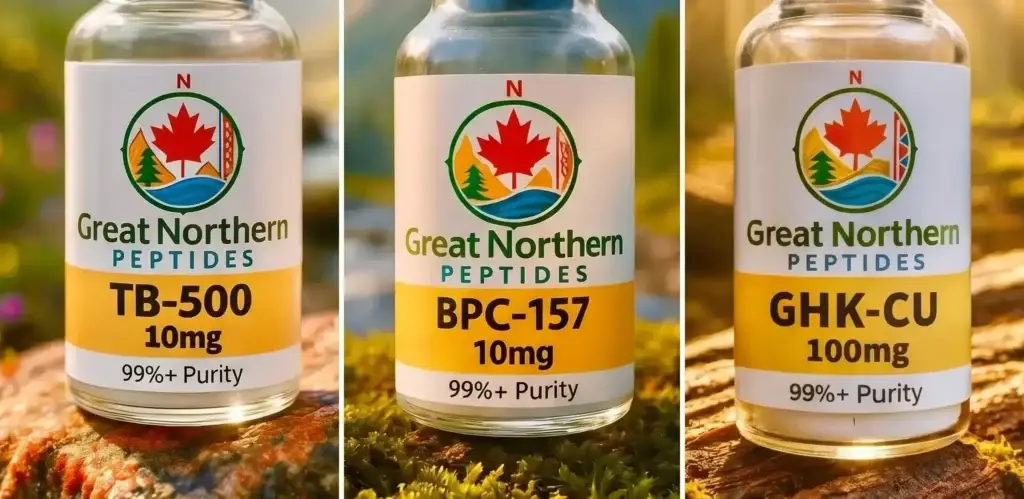
Ready to explore peptides for hair growth? Browse our full selection of research-grade peptides, including GHK-Cu, BPC-157, and TB-500, all shipped from Canada with third-party purity testing.
Great Northern Peptides carries the full range of research-grade peptides Canada researchers trust for hair growth studies and beyond.